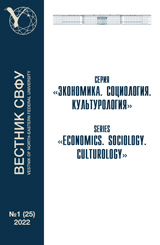
The online periodical publishes articles in the following sciences:
Economic Sciences:
- 5.2.3. Regional and Industrial Economics
Sociological Sciences:
- 5.4.4. Social Structure, Social Institutes and Processes
- 5.4.7. Sociology of Management
Culturology:
- 5.10.1. Theory and History of Culture and Arts
Current issue
Global oil prices are formed based on the balance of supply and demand, determined by the rate of economic growth, the structure of energy consumption, energy efficiency, weather conditions, and competition with alternative fuels. Supply is regulated by the production volumes of key players and investment in the industry. The purpose of this study is to identify the key macroeconomic, geopolitical, and market factors influencing the development prospects of these global oil markets in Asia and Africa. The study identified key factors in the development of global oil markets in Asia and Africa: the demographic dividend, a young population, and the rapid growth of the middle class are generating colossal consumer demand; demand is also driven by the active construction of logistics centers, roads, and ports, including as part of China’s “One Belt, One Road” initiative. The methodological basis of the study was general scientific and empirical methods, systems, comparative, and economic analysis, theoretical methods followed by analysis and generalization of their results. Theoretical methods followed by analysis and generalization of the results (statistical, observational, comparative, balance, and empirical methods) were also applied. This article draws on the research of Russian and international researchers, data from international energy organizations, analytical materials and statistics, and reports and materials on the oil market from renowned global organizations.
The study of the Russian Arctic at the municipal level is associated with a relevant research agenda that reveals the specific features of the socio-economic development of Arctic cities and urban settlements. The economic activity of enterprises and organizations in Arctic cities is determined by their characteristics, which develop, on the one hand, in close connection with resource-based industries, and on the other hand, under conditions of a limited local market for goods and services. The study is based on a synthesis of academic literature and official statistical data by municipal districts. Economic activity at the municipal level reflects the scale of economic development and is represented by two indicators: the number of enterprises and organizations per 1000 population, and the volume of shipped goods of own production, as well as works and services performed in-house, per 1000 population. The analysis is primarily based on a quantitative assessment of economic activity with visual support. A scatter (X, Y) or bubble chart was used as a data visualization method and analytical tool, making it possible to complement a two-dimensional (OXY) graph with three-dimensional data (population size), and to include, in addition to median value lines for the two selected indicators, three more additional variables – number of settlements, transport accessibility, and distance from the city of Yakutsk. A typology was constructed based on two economic activity indicators, identifying leading municipal districts – Verkhoyansky, Ust-Yansky; and weaker municipal districts – Eveno-Bytantaysky, Srednekolymsky, Nizhnekolymsky, Abyisky, Momsky and Zhigansky. Further analysis of the development of economic activities in municipal districts of the Arctic zone of the Sakha Republic (Yakutia) is needed.
Participatory budgeting is a practice of supporting local initiatives aimed at engaging citizens in addressing local issues, which is particularly relevant for municipalities in the Northern and Arctic regions. Participatory budgeting involves selecting a priority public issue and developing measures to address it: proposing a proactive project, as well as co-financing its implementation by local governments, municipal residents, and the regional budget of the constituent entity of the Russian Federation. This mechanism promotes the development of social infrastructure, the conservation of budgetary resources, the creation of conditions for participation in socially beneficial activities for various categories of the population, fosters a sense of ownership of common interests, the ability to monitor the implementation of proactive projects at all stages, and openness and transparency of budget information. The theoretical and empirical information base for this work was provided by scientific research by Russian and international authors, policy documents, reports by government representatives, and statistical data. The purpose of this study was to analyze the implementation of local initiative support programs, including identifying the main areas and amounts of project funding, the degree of local population engagement in participatory budgeting, identifying factors hindering this process, and developing areas for improving and developing participatory budgeting mechanisms in municipalities of the Sakha Republic (Yakutia). These may include, for example, expanding the range of participatory budgeting practices, raising public awareness of the opportunities and mechanisms for implementing these community development support programs, enhancing resident engagement in solving local problems, and digitalizing the participatory budgeting mechanism in the republic and municipalities.
The article examines the market power of digital online food delivery platforms in China and Russia as delivery and e-commerce become part of consumption infrastructure. The research problem is that traditional indicators of market share, price and commission do not sufficiently reflect the influence of platforms that control data, algorithms, access rules, ratings and couriers’ work practices. The purpose of the study was to identify common and specific mechanisms through which food delivery platforms form market power in the Russian-Chinese context and to justify regulatory directions with regard to competition, algorithmic transparency and the protection of platform workers. The materials and methods include a comparative case analysis of Meituan, Ele.me/Taobao Instant Commerce and JD Waimai, analysis of statistical data from Russia and China, academic literature and regulatory legal acts governing online trade, competition, algorithms and platform employment. The Russian material is considered as an applied block that makes it possible to assess the relevance of Chinese experience for eGrocery, O2O services, ecosystem delivery, northern regions of Russia and the Sakha Republic (Yakutia), where remoteness, low population density, climate risks, shortages of workers and high logistics costs increase the dependence of consumers, restaurants and small businesses on intermediaries. The regional empirical part is developed using the Sakha Republic (Yakutia) as an example: the analysis takes into account territorial scale, population density, the concentration of demand in Yakutsk, seasonal navigation and northern supply as factors shaping last-mile costs and platform dependence. The study finds that common mechanisms of market power include network effects, economies of scale and scope, data control, algorithmic management and ecosystem lock-in. China is characterized by a larger user base, high density of instant retail, developed antitrust and algorithmic regulation, and the consolidation of social guarantees for workers in new forms of employment. Russia is characterized by rapid growth of eGrocery and O2O services, the ecosystem role of major digital players and the formation of a legal framework for the platform economy. The practical significance of the study lies in substantiating comprehensive regulation that combines competition, access, algorithmic explainability, social protection of couriers and the prevention of platform dependence in remote markets and northern cities of Russia.
Against the background of the restructuring of the global energy landscape, intensified geopolitical conflicts and accelerated low-carbon transformation, the Arctic is becoming a key region for international energy cooperation. The purpose of this work is to identify sustainable mechanisms of international cooperation in large-scale Arctic projects using Yamal LNG and Arctic LNG 2 as examples. The materials and methods include analysis of open operational data (2017–2025), ownership structure, investment volumes, production capacities, export flows, technical solutions, as well as comparative and systemic approaches. The results show that Yamal LNG implemented an effective Russia–China–Europe trilateral cooperation model, with a 76% share of European exports in 2025. In turn, Arctic LNG 2, under the influence of sanctions, accelerated its reorientation to the Eastern market (about 90% of exports to Asia) and the Eastern supply chain. It is established that the key success factors are: global modular construction (85% of modules produced in China), the Arc7 ice-class fleet ensuring year-round navigation along the Northern Sea Route, long-term take-or-pay contracts, as well as financing and logistics substitution under external pressure. Conclusion: the proposed cooperation models and technical solutions (including GBS platforms) have proven their efficiency, reproducibility, and resilience to external shocks. The practical significance of the work lies in forming an empirical basis for risk management, optimization of cross-border interaction, and further development of the «Polar Silk Road» under changing geopolitical conditions.
The article presents a scenario forecast for organic food production in the Sakha Republic (Yakutia) up to 2040. The relevance of the study is due to the need for a quantitative assessment of the potential impact of the organic sector on agricultural development. Based on an analysis of agricultural output dynamics for 2014–2023, a baseline forecast is constructed using an exponential trend model (R² = 0.9555). Due to significant differentiation in dynamics across municipal districts (coefficient of variation of 21.5%), an adjustment factor is introduced in the form of the median of the average annual growth rate. Three scenarios for the organic sector’s development are adopted: conservative (3% organic share in 2040), baseline (5%), and optimistic (10%). All scenarios share the same initial condition – 1% in 2030. A price premium of 50% for organic products is applied, justified by the high share of livestock in the region’s agricultural structure (66.1% in 2023). The results show that the conservative scenario would increase the average annual growth rate of gross agricultural output by 1.0 p.p. (to 7.4%), the baseline scenario by 1.6 p.p. (to 8.0%), and the optimistic scenario by 3.0 p.p. (to 9.3%). The volume of organic production by 2040 will reach from 3.3 to 13.0 billion rubles depending on the scenario. Comparison with national targets, provided for by the Strategy for the Development of Organic Food Production in the Russian Federation until 2030, confirms the realism and achievability of the developed forecasts. More moderate estimates for Yakutia (organic growth rates 3.2–5.7 p.p. lower than the national average) are due to the objective starting conditions of the region.